.png)

.png)

Sheridan Home Values 2025: What the Data Reveals
⚡ 2025 Market Summary: In 2025, Sheridan County’s housing market combined steady home value growth with a noticeable shift toward a more buyer-leaning environment, as inventory expanded and days on market lengthened compared with prior years. Median sold prices hovered in the mid-$440,000s, with an April market trends report citing a $442,500 median sold price and countywide estimated property values near $395,000, reflecting roughly 6–7% appreciation over the previous year. For homeowners, that meant meaningful equity gains on paper, but also a clear signal that pricing strategy, condition, and positioning mattered more in 2025 than during the ultra-competitive pandemic years.
By the end of 2025, Sheridan homeowners finally had a full year of post-pandemic data to measure how their properties actually performed, rather than relying on headlines or statewide averages. County-level reports showed that while values remained well above pre-2020 levels, the pace of growth moderated as inventory climbed and buyers had more choices, pushing the market closer to balance. With median sold prices around the mid-$440,000s and an estimated property value around $395,170, the story of 2025 was less about runaway appreciation and more about how different price points, property types, and locations responded to a normalizing environment. Having a complete January–December data set allowed homeowners to see how early-year momentum, mid-year inventory gains, and late-year interest rate patterns all worked together to shape their equity picture.
What Happened in 2025: The Year in Review
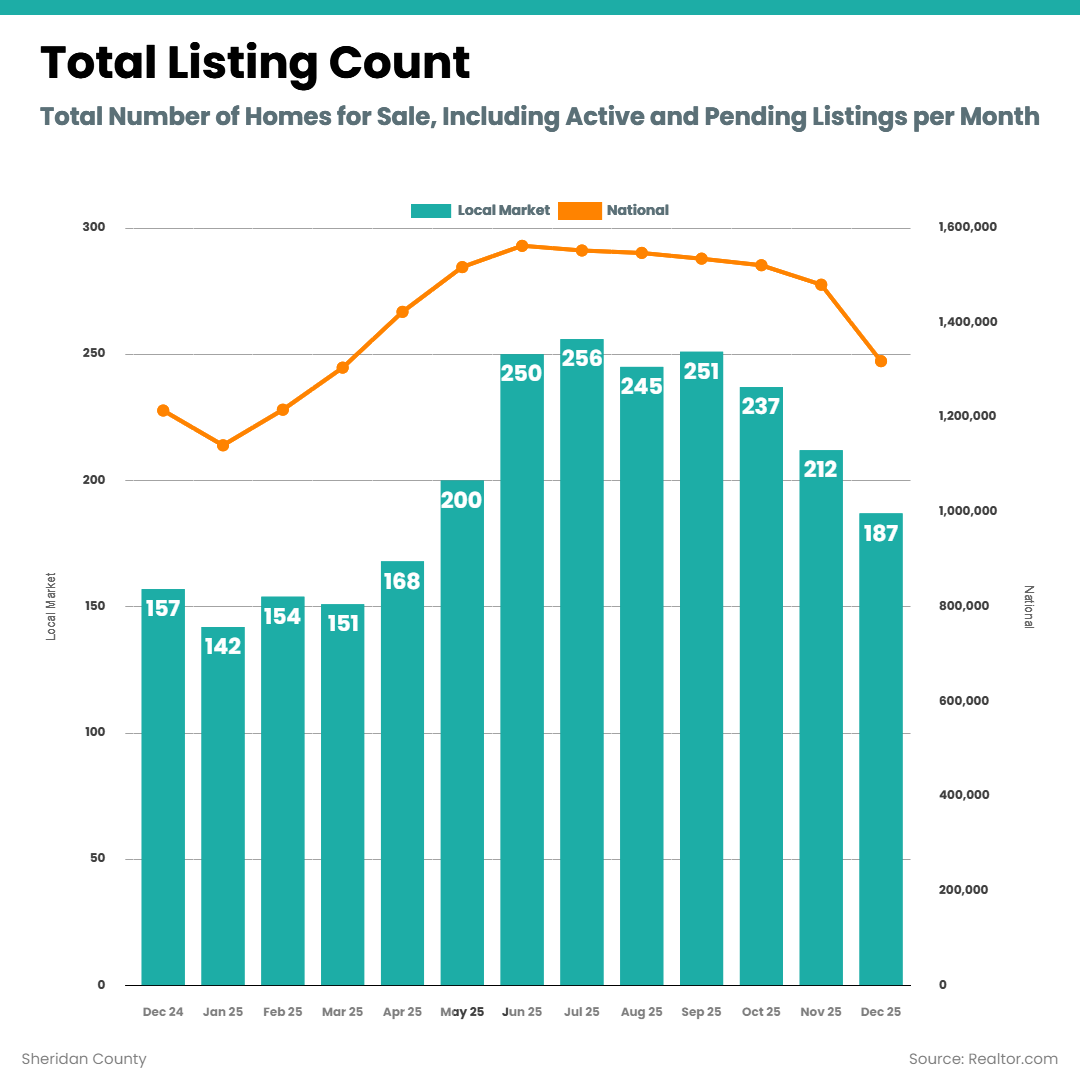
At the macro level, 2025 in Sheridan County was defined by two forces working in tandem: continued price strength and a meaningful build-up in available inventory. Regional housing reports highlighted a median sold price of about $442,500 by April 2025, alongside nearly a year’s worth of homes on the market—around 10–11 months of supply, which is high by Wyoming standards and characteristic of a buyer-leaning environment. That dynamic contrasted sharply with the shortage-driven conditions of prior years, when limited supply and intense competition pushed prices up at a faster clip.
Price performance over the year showed a pattern of healthy but more measured appreciation rather than sudden spikes. Countywide estimates suggested home values rose roughly 6–7% year over year, placing Sheridan above the statewide average pace of growth but below some of the most extreme mountain-resort markets. In practical terms, a home that might have sold in the high-$300,000s to low-$400,000s range in late 2024 often closed closer to the mid-$400,000s by late 2025, provided it was priced in line with nearby comparable sales and presented well.
Quarter by quarter, the narrative was one of gradual transition rather than abrupt change. Early 2025 data showed strong prices supported by residual demand and limited carryover inventory, with buyers still adjusting to higher borrowing costs but moving forward when homes matched their criteria. As spring and summer progressed, more listings came to market, new subdivisions added options, and inventory broadened across several price bands—particularly in the upper ranges—giving buyers added negotiating room. By fall, several reports described Sheridan County as sitting firmly in a more balanced, buyer-leaning position, even as median prices remained elevated.
Mortgage rates formed the backdrop to nearly every 2025 decision. Rather than the ultra-low figures of the early 2020s, late-2025 rates generally hovered in the mid-6% to low-7% range, which influenced affordability and shifted some buyers into more conservative price brackets or longer decision timelines. This did not erase demand; instead, it encouraged more careful evaluation of value, condition, and pricing, contributing to longer days on market and more frequent price adjustments on homes that stretched beyond what recent sales could support.
Seasonal patterns also reasserted themselves after several years of pandemic-disrupted cycles. Traditional listing surges in spring and early summer returned, with many sellers timing entries around weather, school calendars, and relocation schedules, while buyers used slower late-fall and early-winter periods to seek opportunities among homes that remained on the market. For 2025 as a whole, Sheridan’s housing market demonstrated that even in a higher-rate environment, the combination of lifestyle appeal, acreage options, and regional economic stability still supported value growth—just within a more balanced framework where strategy mattered more than sheer momentum.
Neighborhood-by-Neighborhood: 2025 Performance
Within Sheridan County, the broad statistics masked important differences between city, town, and acreage-focused areas. Data from countywide reports showed a median sold price around $442,500 and an estimated median property value near $395,170, but individual neighborhoods and outlying communities often landed above or below those benchmarks depending on proximity to services, land characteristics, and price point. Areas closer to Sheridan’s core amenities, with efficient layouts and updated finishes, frequently tracked near or slightly above the county median, while more remote or highly specialized properties exhibited a wider range of outcomes.
Segments with strong lifestyle alignment—such as acreage homes that balanced privacy with reasonable access to Sheridan—benefited from ongoing interest from both local and out-of-area buyers seeking space and long-term quality of life. In many cases, these properties saw appreciation broadly in line with the county’s estimated 6–7% year-over-year gains, particularly when listings were positioned realistically against recent comparable sales. Conversely, homes that required substantial updates or entered the market at aspirational price points often spent more time on the market and experienced one or more price reductions, even if they ultimately sold at values that remained higher than pre-2020 levels.
Inventory patterns varied across neighborhoods as well. Countywide months of inventory approached roughly 10–11 by mid- to late-2025, but certain pockets saw more concentrated supply in specific price brackets. In higher-end segments, the combination of elevated list prices and a more selective buyer pool led to longer marketing periods, while well-priced homes in the mid-market ranges tended to attract steady interest and more predictable timelines. This divergence created a “split market” feel in some areas, where value-focused buyers enjoyed more choice, yet standout properties in desirable micro-locations still drew strong attention.
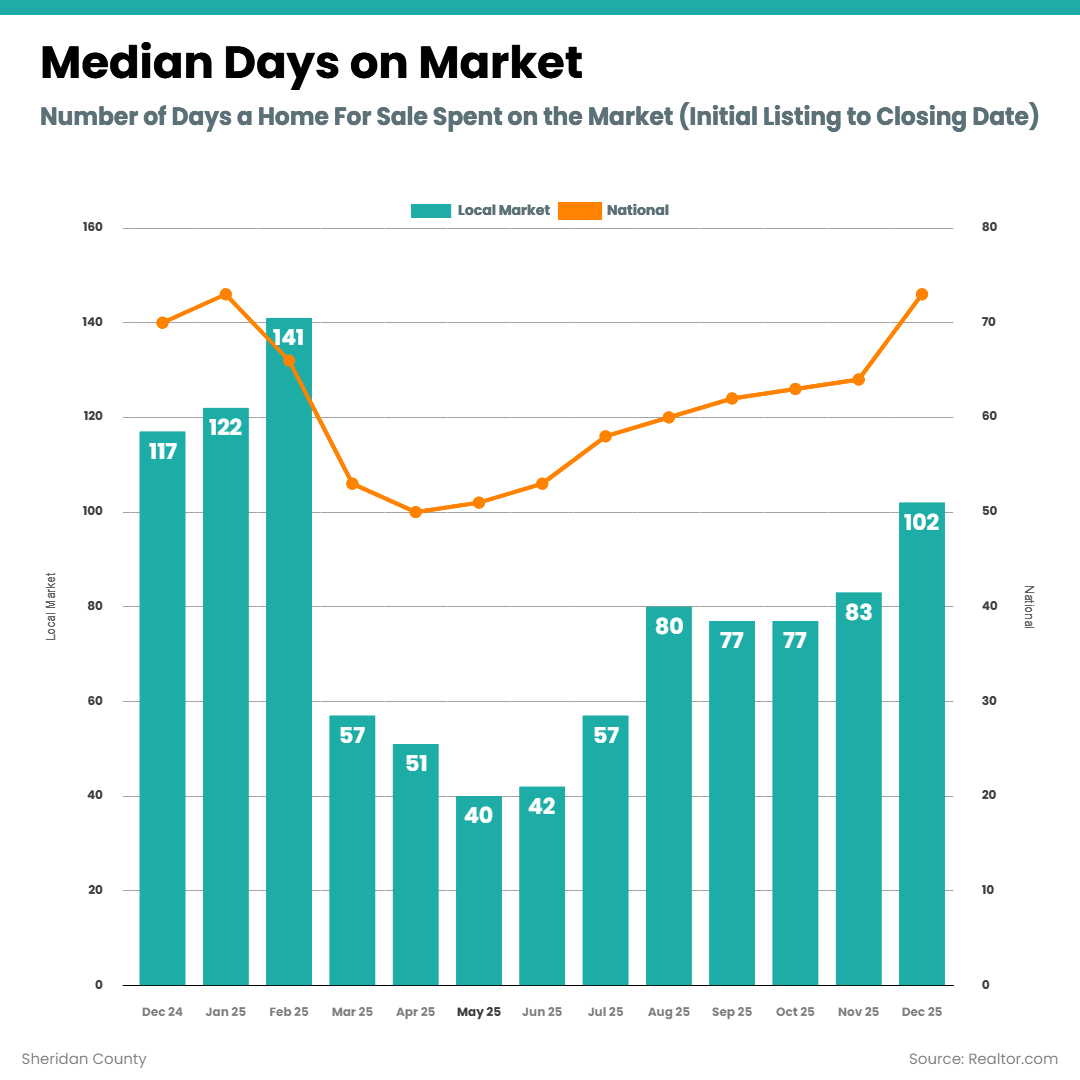
Days on market offered another window into neighborhood-level performance. Countywide numbers showed marketing times lengthening relative to 2023 and 2024, but the experience differed significantly between move-in-ready homes aligned with current buyer expectations and those that needed notable repairs or modernization. In practice, sellers who priced precisely within the band supported by recent sales in their immediate area often saw solid activity early in the listing period, while homes that tested the upper edges of the market typically required more patience and strategic adjustments.
New development also played a role in shaping the 2025 story. Additional subdivisions and projects added options in certain parts of the county, helping increase inventory and influence pricing expectations even for nearby resale properties. For homeowners, this meant that neighborhood performance depended not only on past comparable sales but also on how new supply—whether entry-level, mid-range, or upper-tier—competed for attention and set benchmarks. The result was a 2025 landscape where each zip code, subdivision, and rural pocket needed to be evaluated on its own terms rather than relying solely on countywide averages.
What the 2025 Data Means
For homeowners in Sheridan, the 2025 data told a nuanced but generally positive story about equity. County reports pointing to a median sold price around $442,500 and an estimated median property value near $395,170 confirmed that values remained well above pre-pandemic levels, with roughly 6–7% year-over-year appreciation in many segments. That kind of growth, layered on top of gains from prior years, translated into meaningful paper wealth for owners who had held property through recent cycles, especially those in consistently sought-after locations.
At the same time, the shift to roughly 10–11 months of inventory in 2025 changed how that equity could be accessed. In earlier years, extremely tight supply and multiple-offer scenarios often allowed sellers to outpace recent comparable sales with aggressive pricing strategies. In 2025, success depended more on aligning list prices with current data, presenting homes in strong condition, and responding thoughtfully to feedback and showing activity. Sellers who treated the market as if it were still in peak-surge conditions frequently encountered slower activity and pricing adjustments before reaching the right level.
For owners in neighborhoods that tracked close to or slightly above the county’s median values, the 2025 numbers signaled that their properties generally kept pace with broader trends. Where appreciation mirrored the estimated 6–7% range, equity growth was steady but sustainable, supporting decisions like strategic upgrades, debt reduction, or planning for future moves. In areas where values appeared flatter, the data often reflected local factors such as increased nearby competition, condition differences, or price sensitivity at certain thresholds rather than a generalized market weakness.
For homeowners considering refinancing or restructuring their financial plans, 2025’s more stable environment offered clearer benchmarks than the volatility of prior years. Steady values, combined with mid-6% to low-7% mortgage rates, encouraged careful comparison of options rather than quick reactions to sudden shifts. Understanding how an individual home performed relative to county medians, neighborhood trends, and property type norms became essential for decisions ranging from accessing equity to timing future moves.
Above all, the 2025 data underscored the importance of micro-level analysis. Two homes in the same general price band could have very different trajectories depending on location, acreage, condition, and how they were positioned against current inventory. For owners, relying solely on automated estimates or broad county averages risked overlooking both hidden strengths and subtle headwinds that the year’s numbers brought to light in their specific corner of Sheridan County.
Winners and Lessons from 2025
Looking back on 2025, certain strategies clearly aligned better with Sheridan’s evolving conditions than others. On the selling side, properties that entered the market with data-supported pricing, strong presentation, and realistic expectations tended to secure solid outcomes even as inventory climbed. These homes took advantage of the fact that buyers still valued quality and location, but expected more negotiation room than during the tightest years of the cycle.
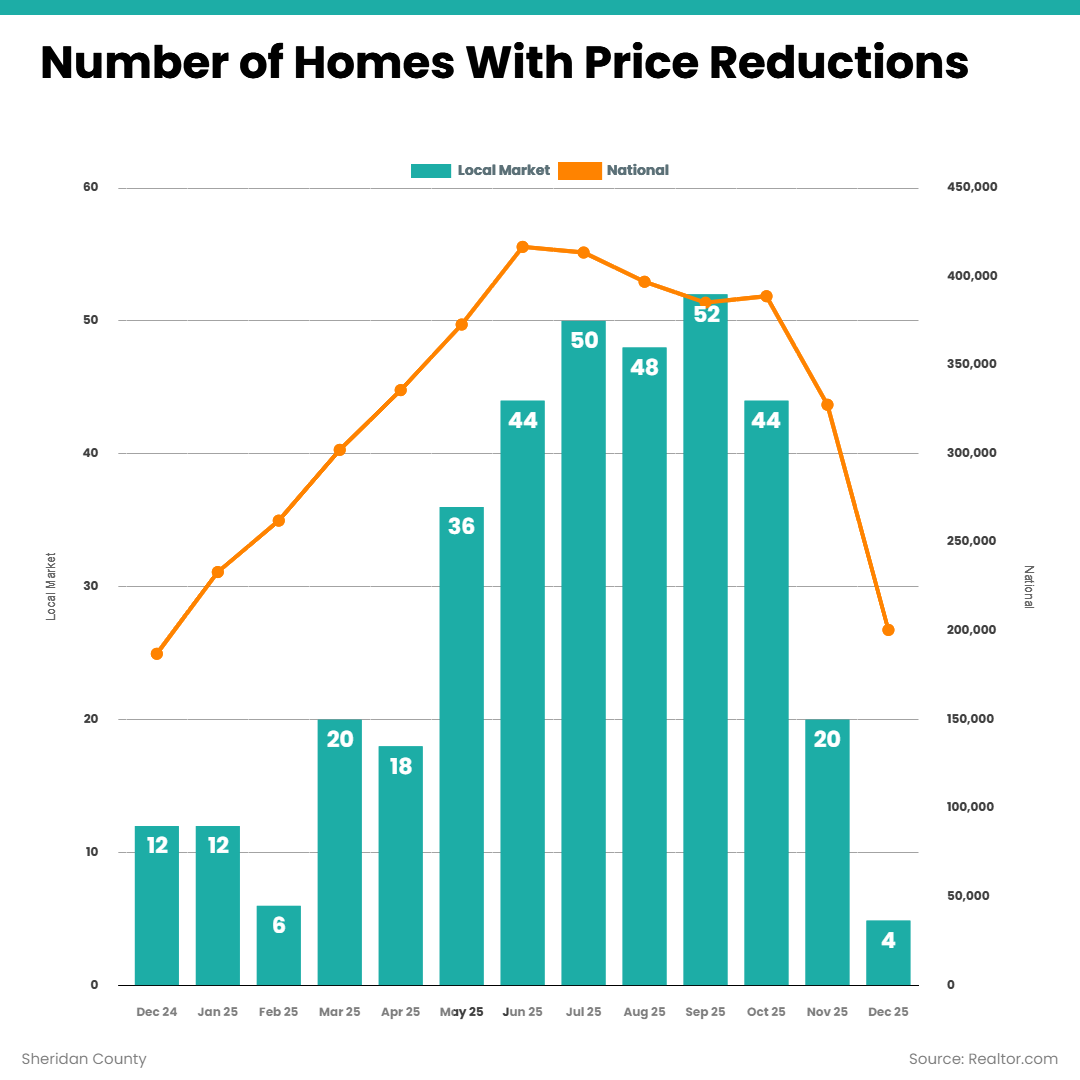
Sellers who treated 2025 as a continuation of the peak surge often learned different lessons. Overly ambitious list prices, limited preparation, or reluctance to adjust strategies in the face of feedback frequently led to longer days on market, multiple price reductions, and a less efficient path to the eventual sale. In an environment with roughly 10–11 months of inventory and more competition, the market rewarded alignment with current data rather than reliance on prior-year momentum.
On the buy side, 2025 provided opportunities that had been scarce in earlier years. Higher inventory levels across Sheridan County meant that purchasers had more options to compare, more time to evaluate, and more room to negotiate terms that fit their financial and practical goals. For many, the key lesson was that while mortgage rates in the mid-6% to low-7% range required careful budgeting, the ability to choose from a broader set of properties and avoid extreme bidding scenarios helped balance the equation.
Investors drew their own conclusions from 2025’s performance. County-level appreciation in the 6–7% range, combined with a more balanced market, favored investors who approached Sheridan as a long-term, fundamentals-driven opportunity rather than a short-term speculation play. Properties with strong underlying demand drivers—such as land, views, or proximity to services—generally produced more reliable outcomes than highly specialized or over-leveraged positions, particularly in segments where new supply increased competition.
For all participants, perhaps the most valuable lesson from 2025 was that Sheridan’s housing market showed resilience while also returning to more historically recognizable patterns. Prices remained strong, yet buyers and sellers each held clearer advantages in specific situations, depending on condition, location, and pricing strategy. The year demonstrated that even in a higher-rate, higher-inventory environment, informed decisions grounded in local data could still produce positive results for homeowners, buyers, and investors alike.
Strategist's FAQ: Understanding Your 2025 Performance
Understanding what happened in 2025 required local market expertise and a data-driven approach that went far beyond countywide averages. Every neighborhood told its own story, and the year’s results showed how properties across Sheridan, Ranchester, Dayton, Buffalo, Big Horn, and the wider county responded differently to shifting inventory, rates, and buyer expectations.